Turn a README into a YouTube Short
Point ReelMint at your project's README and get a script grounded in what the project actually does — then editable scenes: the install command as an animated terminal, the API example as a code card, the architecture as a diagram.
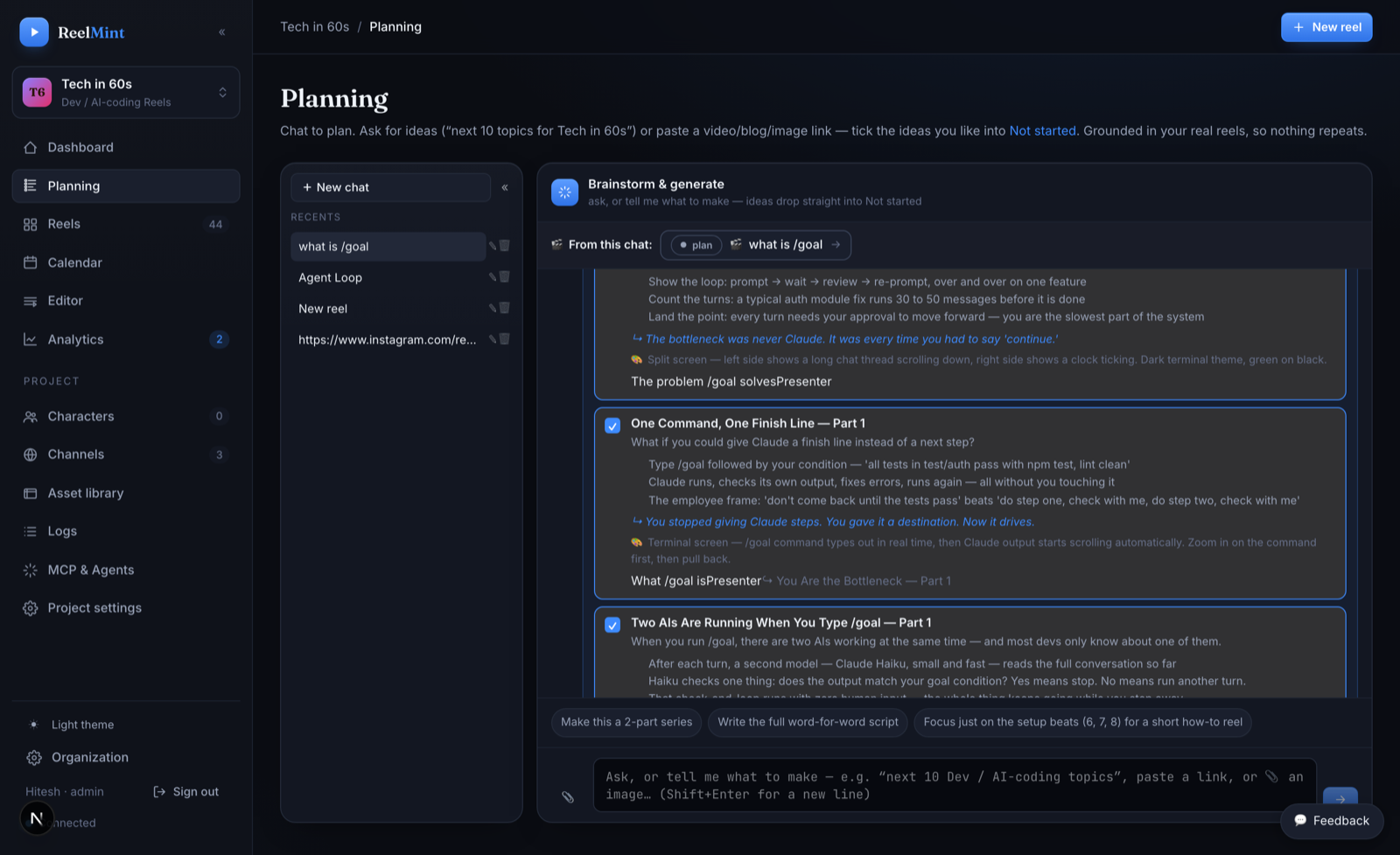
From repo to Short
The README is already the script outline — ReelMint does the rest.
What you get
A Short that looks like your project, because it is your project.
Scripts draw on your knowledge base — README, API docs, past scripts — so the Short says what the repo actually says.
No stock footage of hands typing. Your install command animates in a terminal component; your usage example renders as a real code card.
Scenes stay editable. When the install flag changes or the API is renamed, edit the scene text and re-render — no re-recording.
Publish straight to YouTube or Instagram Reels, or schedule the Short to go live with the release.
Claude Code or Cursor can drive the pipeline through ReelMint's MCP server — useful when a Short per release is the goal.
Bring your own Gemini, OpenAI, or ElevenLabs keys, encrypted at rest, billed by the provider. The pilot itself is free.
Common questions
Does it just read the README aloud?
No. The README grounds the script; the AI writes a Short-length narrative from it — a hook, the problem, the install, the payoff — and you edit every line before scenes are made.
What happens to the code samples in my README?
They become syntax-highlighted code card scenes, sized for a phone screen. Commands become typed terminal animations. Both stay editable afterwards.
The project changed — do I remake the video?
No. Scenes are layered objects, not baked pixels. Update the command or snippet in the scene and re-render the reel.
Can I automate a Short per release?
ReelMint ships an MCP server, so an agent like Claude Code can script, compose, render, and publish with a scoped workspace token — you review the result on your channel.
What does it cost?
The pilot is free with no credit card and no watermarks. Your first 5 videos need no key at all; after that, AI usage runs on your own keys with zero markup.
Other things ReelMint makes
Turn a programming concept into a 9:16 Short built from real, syntax-highlighted code cards — not a cropped screen recording. Every scene stays editable until the moment you publish.
Terminal Demo Video MakerShow a CLI the way it deserves: typed-command animations in a clean terminal component, with monospace type sized for phones — not a desktop screen capture squinted at on a 6-inch screen.
Hinglish Tech Shorts — code-switched narration that actually worksRecord the way you actually teach — Hindi and English in the same sentence, npm and useEffect mid-flow — and get clean, romanized captions aligned word by word. This is the pipeline mainstream tools garble.
Animated Chart Video MakerBar and line charts that grow on screen, driven by your data — real motion components, not a screen recording of a spreadsheet and not a baked animation you can never touch again.
Changelog & Release-Notes Video MakerTurn release notes into a Short people actually watch: PR cards for the headline changes, code cards for the new API, a timeline for what shipped — published to YouTube or Instagram Reels on release day, on schedule.
Your repo deserves a trailer
Paste the README, edit the script, publish the Short — free during the pilot.
Start free — no credit card